

Part 3 of DEI/Publishing Series: Discourse Appropriation for White Imagination
Translation: cis white authors are using social justice rhetoric to defend their hot takes and we're just sitting around thinking that it's okay.

(Stick with me: this third and final entry in my DEI/Publishing series is a bit dense)
There have been a few instances in romance publishing tomfoolery recently where cis white women have defended problematic decisions they’ve made by using social justice rhetoric in their defense arguments.
I love fan fiction and dark romance, two sites of contention where much of this discourse resides, but I also recognize both subgenres as deeply flawed with the potential for improvement. We cannot create a better (safer) space for readers and authors alike if critique and demands for accountability are met with right wing propaganda and victimhood.
Words that fall under the social justice rhetoric umbrella are ‘revolutionary,’ ‘radical joy,’ ‘marginalized,’ and ‘resistance.’
Applied in a modern context (not in the French context where resistance was first coined, because the French were always rebelling) marginalized communities, specifically Black communities in the U.S., use this language to push against power structures that oppress rights and freedoms.
Romance’s appropriation of social justice rhetoric looks like this:
Dark romance is about liberation.
Fan fiction is a vehicle for resistance against oppression.
Small town romances are about radical joy in our political climate.
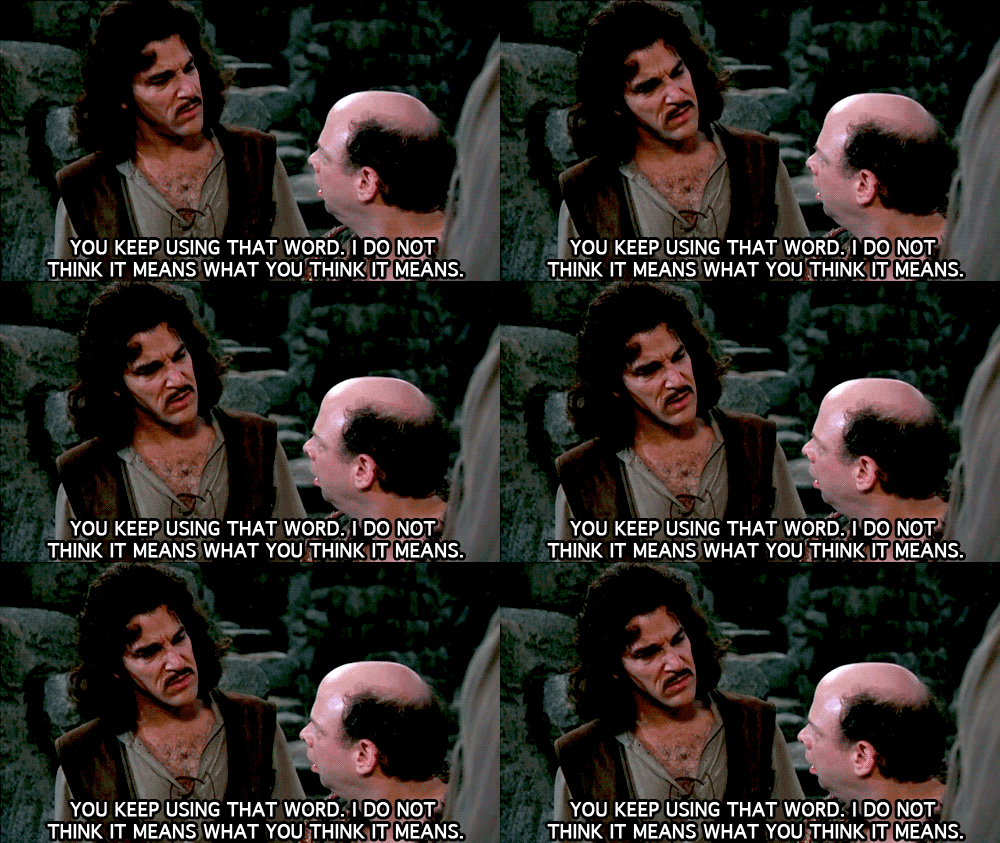
So why is social justice rhetoric used by cis straight white women in romance discourse?
As a developing critical race in literature scholar (where law, racism, race formation and literature intersect), I can’t help but see the connection to Crenshaw’s Indeterminacy of Rights theory. Specifically, the part where Crenshaw believes civil rights laws, policies and discourse is not axiomatic. The language in these laws and policies is written in a way to be flexible and can be utilized to further oppression rather than to dismantle it.
Remember reverse racism? Yeah, it was made possible because civil rights laws were never written in a way to ACTUALLY protect marginalized communities.
Essentially, there is no way to prevent people from coopting words like ‘racism’ and using it as a tool to harm those who it was meant to protect.
This is where we get to discourse appropriation.
Fellow CRT scholar Cheryl Harris wrote a groundbreaking paper titled Whiteness as Property where she discusses the currency of whiteness, personhood and property. Harris believes that equity, equality, racism language has been used as a way to assert racial dominance.
This racial dominance appears in the White Imagination. (Pretend rainbows and sparkles popped out)
Baldwin and Morrison have skirted around this term A LOT so if you’ve read both/either, than you may be familiar with it. There are loads of resources online that dive into the definition with more finesse than I can manage, but to boil it down for the purpose of this discussion: White Imagination is the construction of narratives that centers white experiences. It sells the lie of safety and freedom often by omitting marginalized identities, specifically Blackness, within white-centered stories.1
In the White Imagination, whiteness is oppressed. Whiteness is under attack. Whiteness is marginalized. White women, specifically, can be viewed as misunderstood and unique as they fall in love and find their HEA/HFN.2
Some examples of the White Imagination in romances are cis gendered heterosexual narratives that take place in predominately white communities and/or feature an overwhelming majority white cast of characters. Think small town romances, cowboy romances, military romances, hockey romances, mafia romances, dark academia romances and even SOME fantasy romances.
A lot of readers enjoy novels that center the White Imagination. It’s a reality that we face in our current socio-political climate. Marginalized readers also read romances that center the White Imagination because we exist in a world that is designed for and by white communities so we can navigate and understand the “culture” with deftness. (There is a LOT of nuance to this particular position as to why marginalized readers enjoy these narratives, but that’s a discussion for a different day.)
As you can imagine, the White Imagination is also fraught with racism and prejudice, and this is where authors/publishers have to take responsibility.
In order to communicate the feeling white authors often possess when defending the White Imagination, they can (as we’ve seen in public apology videos, interviews, and Threads posts) co-opt social justice rhetoric in what has sometimes been referred to as political mimicry.
Hopefully, you’re still with me.
Mimicry, in this context, is used to gain legitimacy and trust through language. It’s a way to deflect accountability and it paints a picture of victimhood. It also creates a false sense of allyship with marginalized communities.
By using social justice rhetoric, white authors defending their White Imagination are aligning themselves WITH marginalized communities as if they are saying: I’m also marginalized! I’m just like this oppressed group right here!
The language they use makes them sound like they did their research before putting their problematic work out into the universe. They are creating art (more rainbows and sparkles pop out here) and their art, as well as their identity, are criminally misunderstood.
I mean, you can see how this is terrible, right? You can see why this is not a good thing, and why we shouldn’t support this kind of discursive appropriation?
I’ll spell it out just in case the message was lost in translation:
Using social justice rhetoric to further the White Imagination diminishes the dire need to support marginalized communities by co-opting the messaging and furthering oppression.
It waters down social justice language until it loses its power all together…at a time when words are the most important weapon in our arsenal.
I’m not blaming authors in this situation ENTIRELY by the way. Especially if that author is traditionally published. I’m blaming publishing houses for their responsibility in furthering the White Imagination. I’m blaming publishers for their lack of response when authors are called to the carpet. I’m blaming publishers for their inability to navigate social/PR situations with anything other than complete silence while they make backdoor deals for more special editions.
If you’ve reached this point in my rambling post, and you're still wondering what the CTA is, well:
If you’re an author without color who finds themselves being held accountable for potentially harming a marginalized community through words or actions, then avoid using social justice rhetoric to try to defend your position. That’s a good start.
If we step back a little further, I always ask authors/publishers to take a moment and try to understand the discourse. Why are people upset? What is the reasoning? And what was your (dear author) involvement in creating the current circumstance that has generated backlash?
And most importantly, DO NOT. I Repeat. DO NOT. Cry on the internet and try to defend yourself. Cry in your bathroom. Cry in the group chat. If you cry on social, you’re trying to position yourself as a victim. You’re making a strategic choice.
And lastly, seek some professional guidance on how best to repair the damage you’ve caused to the marginalized community that is seeking answers. You can’t do this on your own. Trust me on this one.
As a bonus, literary citizenship can develop empathy and understanding so that you don’t get into this rut in the first place.
If you’re a reader, avoid using social justice rhetoric to defend terrible hot takes on the internet. If you’re a reader, hold the right people accountable. And if you’re a reader, pick up more books by marginalized authors. It doesn’t hurt to also understand the importance of social justice rhetoric.3
My kid is waking up from her AM nap, and I have about 100 pages left in gender theory to finish before tomorrow so I’m dipping out. I just want to make a quick note that this rant doesn’t have one specific origin. It’s a response to an amalgamation of situations that have occurred over months of sitting on the sidelines.
Thanks for reading, friends.
Hugs,
Nisha

P.S. If you want to show me some love, ILLUSIONS OF FIRE comes out October 7th, and it’s a YA Romantasy with South Asian mythology and Buffy meets Percy Jackson vibes. You can preorder a copy from Doylestown Bookshop for incredible swag, or you can meet me on Book Tour!
If you’re a dark romance reader and you’re interested in horror romance for spooky season, my very short self pubbed novel NOW YOU SEE HIM written as Nina Saxena is available for pre-order now and will be published in e-book and paperback on October 1.
Sadly, I’m referencing an article that’s behind a paywall, but if you’re interested in reading more, check out “White imagination, Black reality: recentering critical race theory in critical whiteness studies” by Benjamin Blaisdell and Rhonda Taylor Bullock.
This is all simplified quite a bit, but if you’re interested in learning more, there is a huge body of theory and study that discusses this ad nauseam. You should start here.
Get out of my head. The rage I feel when I see this happen. I really don’t think these people realize the damage they do to marginalized communities when they co-opt words and phrases for their own purposes. Without context they get weaponized and used against us.
Oh… Nisha. This is so so good. finally saying out loud what so many of us have felt.
When I was young and dumb and writing fanfic, I felt like I had to write white adjacent characters light skinned black folks or even full-on white people to be taken seriously. I used terms like “universal” or “relatable.” when in fact the characters were just white proximal. So yes, the White Imagination is the water we’re all swimming in.
On the contrary side, when you try to write within your culture and speak to your personal experience, we get labeled as “too political” or “not marketable.” The hypocrisy is not subtle either. And you’re right: publishers are complicit. Period. They chase the market, protect the brand, and throw folk especially Brown ones under the bus the moment backlash threatens the bottom line. So thank you for naming what needed to be said 👏🏾
Can’t wait to read Illusions of Fire!❤️❤️